Space Tech’s Earthly Impact: Innovations Reshaping US Industries
Anúncios
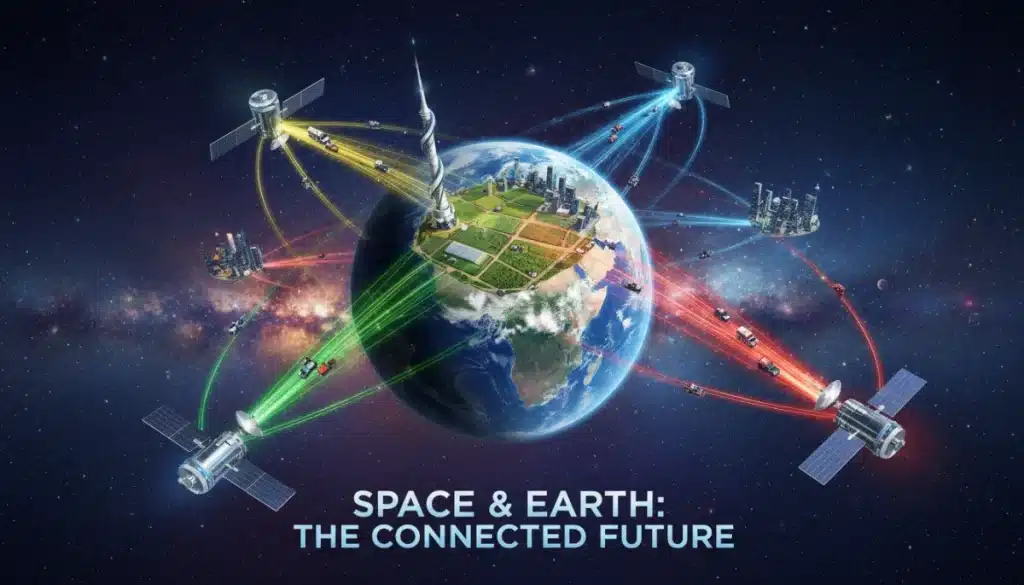
Three pivotal space tech innovations originating from orbit are currently reshaping various United States industries, driving unprecedented advancements in efficiency, connectivity, and environmental stewardship.
The cosmos, once a distant frontier, is now an undeniable engine of innovation right here on Earth. The profound influence of space tech’s earthly impact is no longer a futuristic dream but a present reality, fundamentally transforming how US industries operate. From the satellites circling above to the data beamed down, these orbital advancements are not just about exploration; they are about revolutionizing our daily lives, enhancing efficiency, and fostering resilience across the nation. Let’s delve into how three specific innovations from space are leaving an indelible mark on American industries today.
Anúncios
The Dawn of Precision Agriculture from Orbit
Precision agriculture, a methodology that makes farming practices more accurate and controlled, has been radically transformed by advancements in space technology. Satellites equipped with advanced sensors now provide farmers with an unprecedented level of detail about their fields, leading to optimized resource use and increased yields. This orbital perspective is turning traditional farming into a data-driven science, ensuring sustainability and profitability for American agricultural enterprises.
The ability to monitor crop health, soil conditions, and moisture levels from space allows for targeted interventions. Instead of broad-spectrum applications, farmers can now apply water, fertilizers, and pesticides precisely where and when they are needed. This not only reduces waste and environmental impact but also significantly lowers operational costs, making US agriculture more competitive globally.
Satellite-Based Crop Monitoring
Satellite imagery has become an indispensable tool for modern farmers. High-resolution images, often captured daily, provide insights into plant vigor, disease detection, and growth patterns across vast expanses of land. This detailed data empowers farmers to make informed decisions swiftly.
- Vegetation Indices: Satellites use various spectral bands to calculate indices like NDVI (Normalized Difference Vegetation Index), which indicate plant health and density.
- Disease and Pest Detection: Early detection of stress or anomalies in crops allows for rapid intervention, preventing widespread outbreaks.
- Yield Prediction: By analyzing growth trends and plant health, farmers can more accurately predict harvest yields, optimizing storage and market strategies.
Optimizing Resource Management
Water and nutrient management are critical for sustainable agriculture. Space tech offers solutions that ensure these precious resources are used as efficiently as possible, minimizing runoff and maximizing absorption.
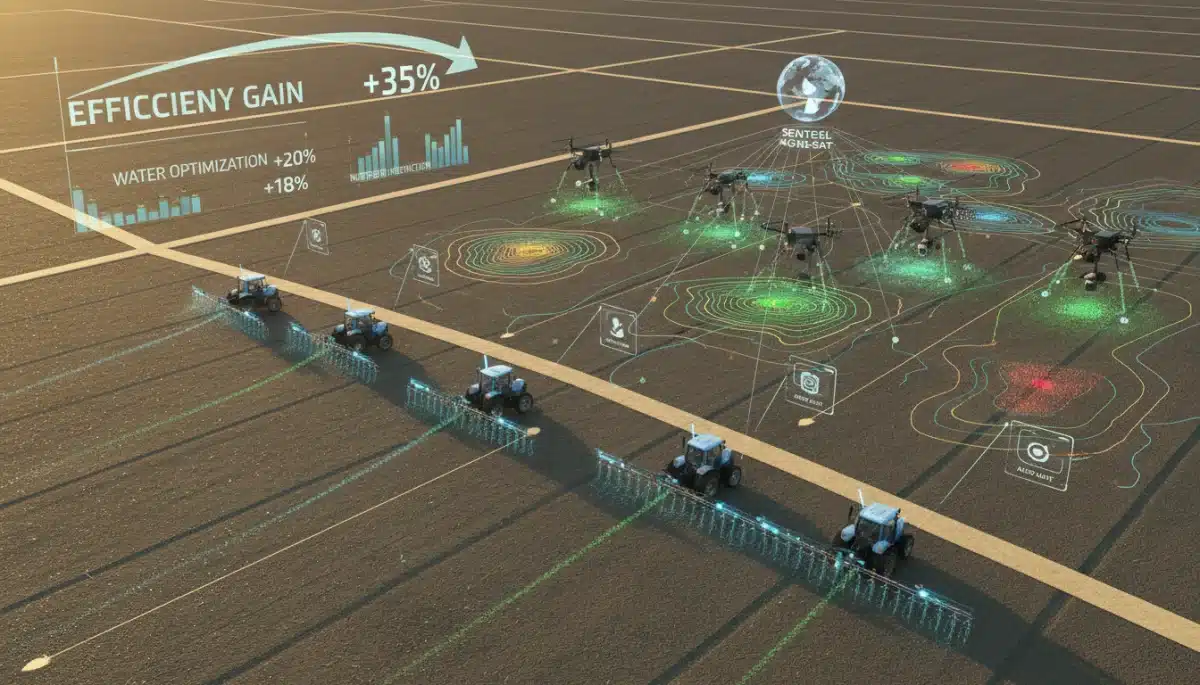
Advanced GPS and GNSS (Global Navigation Satellite System) technologies guide autonomous tractors and farm equipment with centimeter-level accuracy. This precision minimizes overlap in planting, spraying, and harvesting, saving fuel, labor, and valuable inputs. The integration of satellite data with ground-based sensors creates a comprehensive picture of field conditions, enabling highly localized resource application.
The convergence of space-based data and ground operations has ushered in a new era for agriculture. US farmers are leveraging these innovations to produce more food with fewer resources, ensuring food security and economic stability while simultaneously addressing environmental concerns. This systematic approach, driven by orbital technology, is reshaping the very foundation of food production.

Anúncios
Revolutionizing Communication and Connectivity
The demand for ubiquitous and high-speed internet connectivity has never been greater, and space technology is at the forefront of meeting this challenge. Satellite constellations are rapidly expanding, offering broadband access to remote and underserved areas across the United States. This revolution in communication is bridging the digital divide, empowering businesses, and enhancing social equity, showcasing another significant aspect of space tech’s earthly impact.
Traditional terrestrial infrastructure often struggles to reach vast rural landscapes or areas with challenging terrain. Satellite internet bypasses these limitations, providing a reliable and scalable solution that can be deployed almost anywhere. This has profound implications for education, healthcare, and economic development in regions previously left behind by the digital age.
Low Earth Orbit (LEO) Satellite Constellations
The advent of LEO satellite constellations marks a paradigm shift in satellite internet. Unlike geostationary satellites, LEO satellites orbit much closer to Earth, significantly reducing latency and improving speeds. Companies like Starlink are deploying thousands of these satellites, creating a mesh network that promises global coverage.
- Reduced Latency: Closer proximity to Earth means data travels shorter distances, resulting in near-fiber optic speeds and responsiveness.
- Global Coverage: LEO constellations aim to provide internet access even in the most remote parts of the world, including oceans and polar regions.
- Enhanced Reliability: A network of many satellites ensures redundancy and consistent service, even if individual satellites fail.
Impact on Rural and Emergency Services
For rural communities, reliable internet access can mean the difference between stagnation and prosperity. Satellite broadband enables remote work, online education, and telehealth services, bringing opportunities that were once exclusive to urban centers. This ensures that every American has a fair chance to participate in the digital economy.
During natural disasters or emergencies, terrestrial communication networks can often be damaged or overwhelmed. Satellite communication provides a resilient backbone, allowing first responders to coordinate efforts and affected communities to stay connected. This critical capability enhances disaster preparedness and response, saving lives and facilitating recovery efforts across the nation. The expansion of satellite internet is not just about faster downloads; it’s about creating a more connected, resilient, and equitable society.
Advanced Earth Observation and Environmental Monitoring
Space tech’s earthly impact extends significantly into our understanding and management of the environment. Satellites equipped with sophisticated sensors continuously monitor Earth’s systems, providing invaluable data for climate change research, natural resource management, and disaster prediction. This constant vigilance from orbit offers a unique perspective that is crucial for addressing some of the most pressing environmental challenges facing the US today.
From tracking deforestation to monitoring glacial melt, Earth observation satellites gather comprehensive data that informs policy decisions and conservation efforts. This ability to see the bigger picture, and also drill down into granular detail, empowers scientists and policymakers to develop more effective strategies for environmental protection and sustainable development.
Climate Change and Weather Prediction
Satellites play a critical role in monitoring climate change indicators and improving weather forecasting. Instruments measure atmospheric composition, sea levels, ice sheet changes, and ocean temperatures, providing essential data for climate models and predictions.
- Greenhouse Gas Monitoring: Satellites track emissions of carbon dioxide and methane, helping to identify sources and monitor reduction efforts.
- Sea Level Rise: Altimetry satellites precisely measure changes in sea level, offering crucial data for coastal planning and understanding climate impacts.
- Extreme Weather Forecasting: Advanced weather satellites provide real-time data that significantly improves the accuracy and lead time for hurricane, tornado, and other severe weather warnings.
Natural Resource Management and Disaster Response
Effective management of natural resources, such as forests, water bodies, and mineral deposits, heavily relies on data from space. Satellites help assess forest health, monitor water availability, and even detect illegal mining operations.
In the event of natural disasters, Earth observation satellites become indispensable. They provide immediate imagery of affected areas, helping emergency services assess damage, locate stranded individuals, and plan relief operations. For instance, after wildfires, satellites can map burn scars and assess vegetation recovery, aiding in reforestation efforts and future fire prevention strategies. This continuous monitoring and rapid response capability underscores the vital role of space tech in protecting both our environment and our communities.
Enhancing National Security and Infrastructure Resilience
Beyond the civilian applications, space technology plays a critical role in bolstering national security and ensuring the resilience of critical infrastructure within the United States. The strategic advantage gained from orbital assets is immense, providing unparalleled intelligence, surveillance, and reconnaissance capabilities. This aspect of space tech’s earthly impact ensures the safety and stability of the nation against a myriad of threats, both natural and man-made.
From monitoring international borders to tracking potential adversaries, satellites offer a constant watchful eye. This persistent surveillance capability provides decision-makers with timely and accurate information, enabling proactive measures and informed responses. The security benefits extend to protecting vital national assets, including energy grids, communication networks, and transportation systems, against disruptions.
Geospatial Intelligence and Surveillance
Geospatial intelligence (GEOINT), derived from satellite imagery and data, is a cornerstone of modern national security. High-resolution optical and radar satellites can peer through clouds and darkness, providing detailed views of ground activities. This intelligence is crucial for military operations, counter-terrorism efforts, and verifying international treaties.
- Border Security: Satellites monitor vast and often remote border regions, detecting illicit activities and unauthorized crossings.
- Threat Assessment: Regular satellite observations help track military buildups, ballistic missile launches, and other potential threats globally.
- Maritime Domain Awareness: Satellites monitor shipping lanes and coastal waters, identifying suspicious vessels and combating piracy and illegal fishing.
Protecting Critical Infrastructure
The resilience of critical infrastructure against cyberattacks, physical sabotage, and natural disasters is paramount. Space-based assets contribute significantly to this protection by providing real-time monitoring and communication capabilities that are independent of terrestrial systems.
For instance, GPS timing signals are essential for the synchronization of power grids, financial transactions, and cellular networks. Disruptions to these signals could have catastrophic consequences, highlighting the importance of robust and secure satellite navigation systems. Furthermore, satellite communication ensures that emergency services and government agencies can maintain contact even when ground-based networks fail, providing a vital lifeline during crises. The continuous innovation in space tech directly translates into a more secure and resilient nation, safeguarding its people and its vital systems against an evolving landscape of challenges.
The Economic Engine of Space Tech Innovation
The innovations stemming from space technology are not merely improving existing industries; they are actively creating new economic opportunities and fostering significant growth across the United States. The burgeoning space economy, driven by both government investment and private enterprise, is generating high-tech jobs, attracting capital, and spurring further technological advancements. This profound economic aspect of space tech’s earthly impact is transforming traditional sectors and laying the groundwork for future prosperity.
Investment in space infrastructure, from launch services to satellite manufacturing, creates a ripple effect throughout the economy. Companies specializing in everything from advanced materials to data analytics are finding new markets and applications for their expertise. This synergy between space and ground industries is accelerating innovation at an unprecedented pace.
Job Creation and Investment
The space sector is a significant job creator, particularly in high-skilled areas such as engineering, software development, and data science. As new space technologies emerge, so too do the demands for a specialized workforce, driving educational and training initiatives.
- Aerospace Engineering: Design and development of rockets, satellites, and spacecraft require highly skilled engineers.
- Data Scientists: Analyzing the vast amounts of data generated by Earth observation satellites creates demand for data experts.
- Manufacturing and Production: The construction of space hardware fuels manufacturing jobs across various industries.
Spin-off Technologies and New Markets
Historically, space exploration has led to numerous spin-off technologies that have found widespread applications on Earth. From memory foam to advanced water purification systems, the pursuit of space has often yielded unexpected benefits. Today, this trend continues, with space-derived innovations creating entirely new markets.
For example, the miniaturization of sensors and components for satellites is finding applications in consumer electronics and medical devices. The development of AI and machine learning algorithms to process satellite data is revolutionizing fields like logistics, urban planning, and insurance. This continuous cycle of innovation ensures that the economic benefits of space tech extend far beyond the aerospace industry itself, touching almost every sector of the US economy and cementing its role as a powerful engine for growth and development.
Addressing Future Challenges with Orbital Solutions
As the United States faces complex and evolving challenges, from climate change and resource scarcity to rapid urbanization and global competition, space technology offers increasingly vital solutions. The continuous advancement of orbital capabilities promises to provide the tools and data necessary to navigate these future hurdles effectively. The forward-looking dimension of space tech’s earthly impact emphasizes its role not just in addressing current issues but in proactively shaping a more sustainable and resilient future for the nation.
The integration of artificial intelligence and machine learning with satellite data is unlocking new levels of predictive analysis and autonomous operations. This means we can anticipate problems before they escalate, optimize resource allocation with greater accuracy, and respond to crises with unprecedented speed and efficiency. The synergy between advanced computing and orbital platforms is a game-changer for future societal and industrial development.
Smart Cities and Urban Planning
Satellite data is increasingly being used to inform smart city initiatives and urban planning. By monitoring urban sprawl, traffic patterns, and infrastructure development from space, city planners can make data-driven decisions to create more livable and sustainable urban environments.
- Traffic Management: Real-time satellite data combined with ground sensors can optimize traffic flow and reduce congestion.
- Infrastructure Monitoring: Satellites can detect subtle changes in ground elevation or structural integrity, helping to prevent infrastructure failures.
- Resource Distribution: Monitoring energy consumption and waste generation from space can inform policies for more efficient resource allocation within cities.
Sustainable Resource Management
The long-term sustainability of our planet hinges on responsible resource management. Space technology provides the global perspective required to monitor and manage critical resources on a planetary scale, ensuring their availability for future generations.
This includes precise mapping of water bodies, monitoring of freshwater reserves, and tracking of biodiversity hotspots. The ability to observe these changes over time allows for the development of sustainable practices and conservation strategies. Furthermore, the development of in-space manufacturing and resource utilization technologies, while still nascent, holds the promise of reducing our reliance on Earth’s finite resources by leveraging materials found in space. This visionary approach to resource management, fueled by space tech, positions the US to lead in environmental stewardship and long-term sustainability, ensuring a prosperous future for its industries and its citizens.
| Key Impact Area | Brief Description of Transformation |
|---|---|
| Precision Agriculture | Satellite data optimizes crop monitoring, resource allocation, and yield prediction, boosting efficiency and sustainability. |
| Enhanced Connectivity | LEO satellite constellations provide high-speed internet to remote areas, bridging the digital divide and aiding emergency services. |
| Environmental Monitoring | Earth observation satellites offer critical data for climate research, disaster prediction, and sustainable resource management. |
| National Security | Orbital assets provide crucial intelligence, surveillance, and resilient communication for critical infrastructure protection. |
Frequently Asked Questions About Space Tech’s Earthly Impact
Space tech, through satellite imagery and GPS, enables precision agriculture. Farmers can monitor crop health, soil conditions, and moisture levels with high accuracy, leading to optimized water, fertilizer, and pesticide use. This reduces waste, lowers environmental impact, and enhances resource efficiency for sustainable farming practices.
LEO (Low Earth Orbit) satellite constellations are networks of satellites orbiting closer to Earth than traditional ones. This proximity significantly reduces data latency and increases internet speeds. For the US, they provide high-speed broadband to remote and rural areas, bridging the digital divide and enhancing connectivity for various industries and communities.
Satellites continuously monitor Earth’s systems, collecting data on climate change indicators like sea levels and greenhouse gases. For disaster response, they provide immediate imagery of affected areas, helping emergency services assess damage, locate individuals, and plan relief efforts, greatly improving preparedness and recovery.
Yes, satellite data is crucial for smart city initiatives. It helps monitor urban sprawl, traffic patterns, and infrastructure development. City planners use this information to make data-driven decisions for optimizing traffic flow, managing resources, and enhancing the overall sustainability and livability of urban environments.
Space tech innovation is a significant economic engine, creating high-tech jobs in engineering, software, and data science. It attracts substantial capital investment and fosters new markets through spin-off technologies. Industries from logistics to insurance benefit from space-derived data and advancements, driving growth and competitiveness across the US economy.
Conclusion
The pervasive influence of space technology on US industries is undeniable, marking a transformative era driven by innovation from orbit. From revolutionizing agricultural practices with unprecedented precision to bridging connectivity gaps and providing critical environmental insights, space tech’s earthly impact is reshaping how we live, work, and interact with our world. These advancements are not only fostering economic growth and creating new opportunities but also enhancing national security and building a more resilient future. As we continue to push the boundaries of space exploration, the benefits reaped here on Earth will undoubtedly continue to expand, cementing space technology as a cornerstone of progress for the United States.
