Blockchain in US Health Records: Security & Interoperability by 2026

Anúncios
Blockchain technology is set to redefine the landscape of healthcare in the United States by 2026, providing a robust framework for enhanced security and seamless interoperability of patient health records.
The future of healthcare in the United States is rapidly evolving, with technology paving the way for unprecedented advancements. Among these, blockchain health records stand out as a revolutionary force, promising to reshape how patient data is managed, secured, and shared. By 2026, this distributed ledger technology is expected to significantly enhance both the security and interoperability within the U.S. healthcare system, addressing critical challenges that have long plagued the industry.
Anúncios
Understanding Blockchain Technology in Healthcare
Blockchain, often associated with cryptocurrencies, is fundamentally a decentralized, distributed ledger that records transactions across many computers. In healthcare, this technology offers a tamper-proof and transparent way to manage patient data, moving beyond traditional, siloed systems. Its inherent architecture provides a new paradigm for data integrity and access control.
The core principle of blockchain involves chaining together blocks of data, each cryptographically linked to the previous one. This creates an immutable record, meaning once data is entered, it cannot be altered or deleted. This feature is particularly valuable in a field where data accuracy and audit trails are paramount for patient safety and regulatory compliance.
Key Characteristics of Blockchain for Health Records
- Decentralization: No single entity controls the entire network, reducing single points of failure and increasing resilience.
- Immutability: Records are permanent and unchangeable, ensuring data integrity and preventing fraud.
- Transparency (controlled): While data is encrypted, the ledger itself can be transparent to authorized parties, enhancing trust.
- Security: Cryptographic hashing protects data, making it extremely difficult for unauthorized access or manipulation.
As we approach 2026, the foundational understanding of blockchain’s unique attributes is crucial for appreciating its potential impact on health records. It’s not just about storing data, but about creating a verifiable and secure ecosystem for medical information.
Enhancing Security of Health Records with Blockchain
One of the most pressing concerns in healthcare is the security of sensitive patient information. Traditional centralized databases are often vulnerable to cyberattacks, data breaches, and unauthorized access. Blockchain technology offers a robust solution by fundamentally altering the security landscape.
The decentralized nature of blockchain means there is no central server to target, making it significantly harder for malicious actors to compromise the entire system. Instead, data is distributed across multiple nodes, and any attempt to alter a record on one node would require altering it on every other node simultaneously, which is practically impossible due to cryptographic linking.
Advanced Encryption and Access Control
Blockchain utilizes advanced cryptographic techniques to secure individual data entries. Each patient record can be encrypted, and access can be granted through private keys, ensuring that only authorized personnel can view specific information. This granular control over access is a significant improvement over current systems where broad access often leads to vulnerabilities.
- Private Keys: Patients and providers can control access to their data using unique cryptographic keys.
- Audit Trails: Every access and modification to a health record is logged on the blockchain, creating an unalterable audit trail.
- Data Integrity: The immutable nature of the ledger ensures that patient data remains accurate and untampered, crucial for diagnosis and treatment.
By 2026, the integration of blockchain into health record systems is expected to drastically reduce instances of data breaches and enhance patient trust in the digital management of their medical history. This improved security framework is a cornerstone of the technology’s promise.
Anúncios
Revolutionizing Interoperability in US Healthcare
Interoperability, the ability of different information systems and software applications to communicate, exchange data, and use the information that has been exchanged, remains a significant challenge in the US healthcare system. Fragmented data across various providers, hospitals, and clinics often leads to inefficiencies, medical errors, and delayed care. Blockchain offers a powerful solution to this long-standing problem.
By creating a shared, secure, and standardized ledger, blockchain can facilitate seamless data exchange between disparate healthcare systems. Instead of complex, often incompatible interfaces, healthcare providers can access a patient’s comprehensive medical history from a single, trusted source, provided they have the necessary authorization.
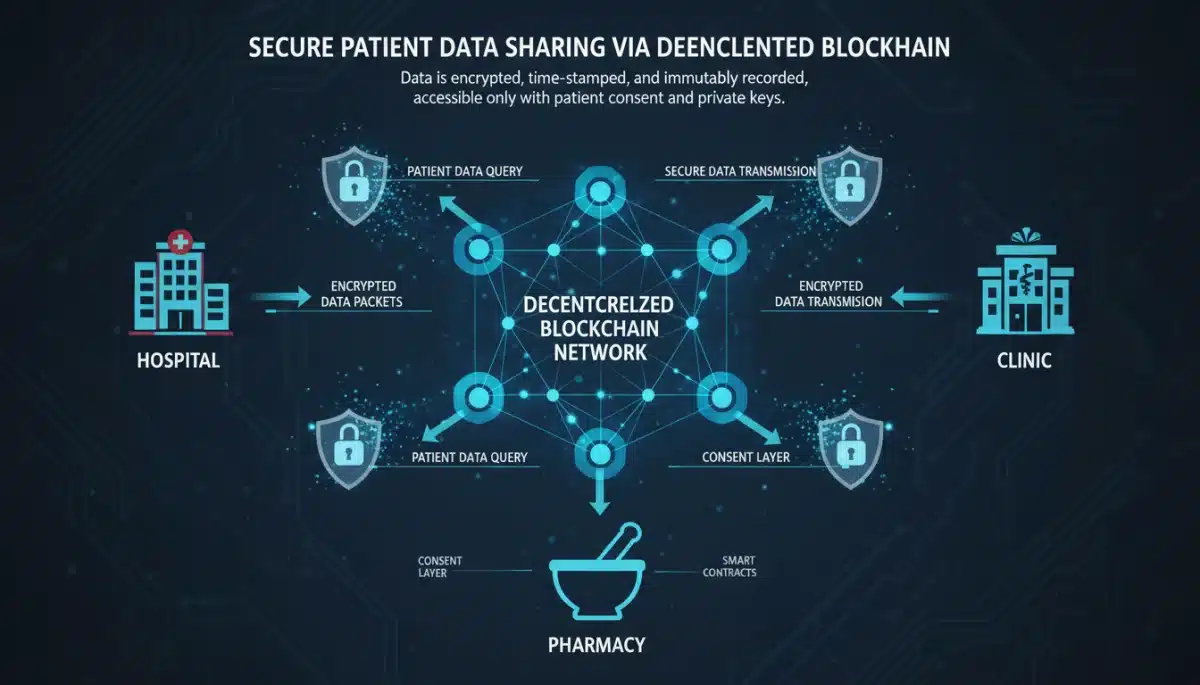
This streamlined approach eliminates the need for redundant tests, improves coordination of care, and empowers patients with greater control over their health information. The ability to quickly and securely share critical data, such as allergies, medications, and past diagnoses, can be life-saving in emergency situations.
Overcoming Data Silos and Promoting Collaboration
- Standardized Data Formats: Blockchain can enforce common data standards, making it easier for different systems to interpret information.
- Real-time Access: Authorized providers can access up-to-date patient information instantly, improving decision-making.
- Patient-Centric Approach: Patients can grant and revoke access to their records, fostering a more patient-centric healthcare model.
The promise of true interoperability through blockchain by 2026 could transform the operational efficiency of the US healthcare system, leading to better patient outcomes and reduced administrative burdens.
Challenges and Hurdles for Blockchain Adoption
While the potential benefits of blockchain in health records are immense, its widespread adoption in the US healthcare system by 2026 is not without significant challenges. These hurdles range from technological complexities to regulatory and cultural resistance, requiring a concerted effort from all stakeholders.
One primary concern is scalability. Current blockchain technologies, especially public ones, can struggle with the sheer volume of transactions and data generated by the entire healthcare system. Storing vast amounts of detailed medical images or genomic data directly on a blockchain might not be practical, necessitating hybrid solutions where only pointers or hashes are stored on-chain, with the actual data off-chain.
Regulatory and Standardization Issues
The highly regulated nature of healthcare, particularly in the US with HIPAA compliance, presents a complex landscape for blockchain integration. New regulations or adaptations of existing ones will be necessary to accommodate decentralized data management. Furthermore, a lack of industry-wide standards for blockchain implementation could hinder interoperability even within blockchain-based systems.
- Regulatory Compliance: Navigating HIPAA and other privacy laws while implementing decentralized systems.
- Interoperability Standards: Developing universal standards for blockchain in healthcare to ensure seamless data exchange across different platforms.
- Data Migration: The immense task of migrating existing patient data from legacy systems to new blockchain-based platforms.
Overcoming these challenges will require significant investment, collaboration between technology developers and healthcare providers, and proactive policy-making to realize blockchain’s full potential.
Use Cases and Pilot Programs in the US
Despite the challenges, numerous pilot programs and initiatives are already exploring the application of blockchain technology in health records across the United States. These early adopters are demonstrating the practical benefits and identifying best practices for future widespread implementation.
One notable use case involves managing consent for data sharing. Blockchain allows patients to explicitly control who can access their medical information and for what purpose, creating an auditable trail of consent. This empowers patients and ensures compliance with privacy regulations. Another area is supply chain management for pharmaceuticals, where blockchain can track drugs from manufacturing to delivery, combating counterfeiting and ensuring product authenticity.
Examples of Blockchain in Action
Various healthcare organizations and tech companies are investing in blockchain solutions. For instance, some projects focus on secure sharing of medical research data, allowing researchers to access anonymized patient data while maintaining privacy. Others are building platforms for credentialing healthcare professionals, streamlining the verification process and reducing administrative overhead.
- Patient Consent Management: Giving patients granular control over who accesses their health data.
- Drug Supply Chain Tracking: Enhancing transparency and authenticity in pharmaceutical distribution.
- Provider Credentialing: Streamlining the verification of healthcare professional qualifications.
These early successes provide a roadmap for broader adoption and illustrate how blockchain can solve specific, high-value problems within the healthcare ecosystem as we move towards 2026.
The Future Outlook: Blockchain in Healthcare by 2026
Looking ahead to 2026, the role of blockchain in health records within the United States is expected to transition from experimental to increasingly integrated. While full-scale overhaul of the entire system may still be a distant goal, significant progress in specific areas is highly anticipated. The focus will likely be on hybrid models that leverage blockchain for its security and interoperability benefits while maintaining efficiency for large data sets.
We anticipate a greater number of specialized blockchain applications, particularly in areas like claims processing, where the transparency and immutability of the ledger can reduce fraud and streamline payments. The development of interoperability standards will accelerate, driven by both industry consortia and government initiatives, creating a more cohesive digital health infrastructure.
Key Developments Expected by 2026
- Hybrid Blockchain Models: Combining public and private blockchains for optimal security and performance.
- Increased Patient Empowerment: Greater control for patients over their health data through user-friendly interfaces.
- Standardized APIs and Protocols: Facilitating easier integration of blockchain solutions with existing EHR systems.
- Regulatory Clarity: Evolving legal frameworks to support and govern blockchain use in healthcare.
By 2026, blockchain will not just be a buzzword but a tangible component of the US healthcare system, underpinning more secure, efficient, and patient-centric health record management.
| Key Aspect | Impact by 2026 |
|---|---|
| Data Security | Significantly reduced breaches and enhanced patient data protection through immutability and encryption. |
| Interoperability | Improved data exchange across providers, fostering better coordinated care and efficiency. |
| Patient Control | Empowered patients with greater control over access and sharing of their health records. |
| Operational Efficiency | Streamlined administrative processes like claims, credentialing, and supply chain management. |
Frequently Asked Questions About Blockchain in Health Records
Blockchain enhances security through decentralization, making it harder to hack a single point of failure. It uses advanced encryption and creates immutable, time-stamped records, ensuring data integrity and preventing unauthorized alterations. Every transaction is cryptographically linked, forming a tamper-proof audit trail.
Interoperability refers to the seamless exchange and use of information between different healthcare systems. Blockchain facilitates this by providing a shared, secure, and standardized ledger accessible to authorized providers. This eliminates data silos, allowing for a comprehensive view of a patient’s medical history across various institutions.
It is unlikely that blockchain will fully replace all traditional Electronic Health Record (EHR) systems by 2026. Instead, a hybrid approach is more probable. Blockchain will likely integrate with existing EHRs, providing a secure layer for data exchange, consent management, and audit trails, rather than becoming the primary data storage for all records.
Key challenges include scalability issues for handling vast amounts of data, navigating complex regulatory compliance like HIPAA, establishing industry-wide interoperability standards, and the significant cost and effort involved in migrating existing legacy data to new blockchain platforms. Cultural resistance to new technologies is also a factor.
Blockchain empowers patients by giving them greater control over who accesses their health information. Through cryptographic keys and smart contracts, patients can grant and revoke access permissions to specific providers or researchers, ensuring their data is shared only with explicit consent and creating a transparent record of all access attempts.
Conclusion
The journey towards integrating blockchain into the United States healthcare system for health records is a complex yet promising one. By 2026, the technology is set to significantly bolster data security, mitigate the risks of cyber threats, and finally address the long-standing challenges of interoperability. While hurdles in scalability, regulation, and standardization remain, ongoing pilot programs and increasing investment suggest a future where patient data is more secure, accessible, and ultimately, more beneficial for coordinated care. The transformative power of blockchain offers a clear path towards a more efficient, transparent, and patient-centric healthcare landscape in the coming years.
